MI forms with its human host a close symbiosis that is the product of hundreds of thousands of years of joint evolution: it exercises metabolic, nutritional and defense functions that are indispensable to the human being while it delivers nutrients and adequate conditions for its development. Although the bacterial composition of MI varies from healthy subject to healthy subject.
This intestinal microbiota acts deeply on the function of the intestinal barrier as a defense of the organism, the processes of digestion /absorption of nutrients, and degradation of proteins and lipids of the intestinal cell. Due to its physiological impact on the rest of the human body, MI is currently recognized as one more organ of the human superorganism and, like many other organs, can be transplanted from one individual to another.
The balance of this digestive ecosystem depends on three components: the type of microorganisms, permeability of the intestine and local immunity. And if something affects it, it affects the whole body.
. Un gran número de enfermedades del sistema digestivo (diarrea, síndrome de intestino irritable), del sistema inmune (alergia, diabetes de tipo 1, esclerosis múltiple), del sistema nervioso central (autismo, esquizofrenia) o metabólicas (obesidad y diabetes 2 ) están asociadas con alteraciones de la MI, de la función intestinal de barrera y de inmunidad local digestiva, El concepto de prebiótico y probiótico ha sido desarrollado en el marco de la MI; ambos compuestos pueden ser considerados como herramientas nutricionales de interés para restablecer el equilibrio de la MI en los individuos cuya enfermedad está asociada. Los resultados de estudios sugieren que la incorporación de prebióticos a la dieta y alimentos fermentados puede ser una estrategia interesante para controlar el apetito mediante la modulación de la MI.
In general terms, the MI of obese subjects has a lower biodiversity than that of normal weight subjects. Those individuals with lower biodiversity tend to have higher adiposity, insulin resistance, dyslipidemia and a more pronounced inflammatory phenotype compared to those with high biodiversity.
Some authors have proposed that the presence in the IM of high concentrations of Staphylococcus aureus and low concentrations of Bifidobacterium spp. In childhood it could predict the future appearance of overweight or obesity.
The foods that favor the intestinal development of these enterobacteria are those that are in a state of fermentation, industrialized foods such as organic dairy such as:
- Yogurt
- Fermented Milk.
- Organic cheese
- Tempeh ( soybean )
- Miso soybeans and seeds
- Sauerkraut
- Kefir
- Kimchi
- Onion
- Olives
The incidence of diabetes in germ-free subjects is higher. Diabetes mellitus 1 rates are higher in countries with strict hygiene standards where the development of germs is naturally avoided.
Inflammation is a hallmark of obesity and diabetes 2 and the microbiota directly impacts key metabolic pathways for energy and inflammatory balance. 70% of immune cells are in the digestive tract, if we maintain a harmony between microbiota, intestinal barrier and immune system, we avoid the presence of disease.
The following table represents the interrelation of our bacterial microbiota and the different pathologies:
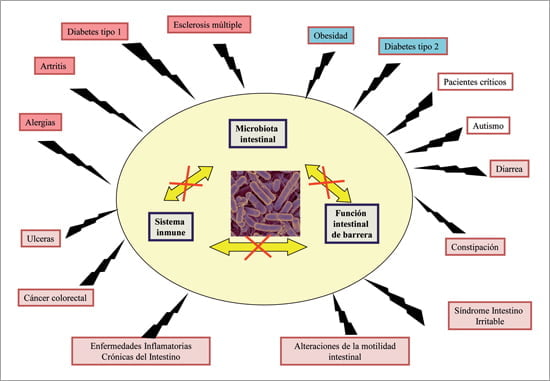
During the last ten years, the characterization and knowledge of the IM of the human being have progressed considerably. Currently, MI is considered an important player in the regulation of the body's energy metabolism, in particular through the colonic rescue of energy from dietary fiber and the regulation of fat storage by adipocytes. The MI of obese and T2DM patients is altered, compared to that of healthy individuals, and would be more efficient in extracting energy from food. Dietary fat intake also alters the composition of MI.
Lic. Sandra Villarreal – Mp 1138
Nutrition Area
La Posada del Qenti


Hello , I am from the province of Santa Fe , I would like to know how much my health can improve and how much I would lose weight, I have 10 kg more, to be moderately well and the costs and days of the August promotion to lose weight. I am 64 years old . I do gymnastics and walk
Ma. Cristina, thank you for your inquiry, you will be receiving all the information in your email. Regards!
I am type 2 diabetic. I can't coordinate my diet with my energy.What should I do? Thank you
Liliana le invitamos a que lea esta nota: https://www.qenti.com/alimentacion-y-diabetes/
La misma habla sobre alimentación y diabetes, no obstante lo ideal es que consulte a nutricionista que pueda evaluar su caso en detalle.
Regards!
Buenas tardes tengo 48 años y un exceso de peso descontrolado debido a varias causas cansancio problemas afectivos ausentes ( perdida repentina de padres ) aumento de diabettes….por momentos y disminución de glóbulos rojos …..me encantaría poder curarme ya q entre la diabetologa nutricionista etc ….aumento de peso. Y me pongo peor y me siento peor. Gracias .
Jorgelina, gracias por su consulta, estará recibiendo toda la información en su correo. Saludos!
Muy interanste la nota. Tengo diverticumos y colon irritable. No se q comer… aparte estoy excedida de peso 80 kg. Y tengo 60 años😣
Interesante nota,tengo intolerancia a muchos alimentos como ser verdura de hoja,cebolla,y todo lo que precisamente fermenta y no consigo bajar de peso pese a llevar una dieta controlada-Ya he probado dejar harinas,comer solo proteina,sin resultado alguno.
cuanto me costaria estar una semana
Silvia, gracias por su consulta, estará recibiendo toda la información en su correo. Saludos!
Un buen lavaje intestinal con una manguera conectada a un grifo y gran parte de los problemas se solucionan.
Estimado Norberto , dicha practica no se considera adecuada ya que barre con toda microbiota intestinal , tan indispesable para nuestro equilibrio metabolico .
atte lic Villarreal
Soy de Santa Fe, tengo 59 años y un sobrepeso de aproximadamente 11 a 12 Kg. Necesitaría bajar. Recientemente me hicieron una litotricia por cálculos renales y necesitaría acomodar mi dieta para su prevención. Hago gimnasia, pero no consigo bajar o si lo hago al dejar pasar unos días nuevamente subo de peso y no logro mantener un peso bajo. Cuanto tiempo sería aconsejable permanecer para lograr resultados y los costos de dicha estadía. Me quedaría bien para el mes de Septiembre. Desde ya muchas gracias. Saludos
Gerardo, gracias por su consulta, estará recibiendo toda la información en su correo. Saludos!
tengo 69 años y peso 82 kg debo pesar 58 segun el medico tengo hosteoporosis y estoy haciendo el tratamiento lo que me cuesta es rebajar y cumplir las normas me falta energia y ganas
Cuanto me sale una semana fines de agosto relajación y descenso de peso
Mabel, gracias por su consulta, estará recibiendo toda la información en su correo. Saludos!
Buenas Tardes:
quiero equilibrar mi alimentación para disminuir mi peso, ya que tengo muchos kilos de mas Mido 1,77 y tengo 115 Kilos.
A pesar de ello, mis análisis clinicos recientes arrojaron valores normales en colesterol, trigliceridfos, glucemia, uremia etc.
Muchas Gracias
Claudio
Claudio, gracias por su consulta, estará recibiendo toda la información en su correo. Saludos!
Yo quisiera adelgazar unos 5 kilos y no puedo hacerlo quisiera información de algún programa para insulino resistente
María, gracias por su consulta, estará recibiendo toda la información en su correo. Saludos!
Quisiera poder consultar por telefono algunas cosas y precio para ir.
Mario puede llamarnos al 0810 345 5656 Saludos!
Hola mi nombre es fredesvinda ramirez necesito saber cuántos me sale estar en relax y con tratamiento 9 dias en el lugar tengo sobre peso y no puedo correr por un accidente que tuve.
Fredesvinda, gracias por su consulta, estará recibiendo toda la información en su correo. Saludos!
Hola tengo 54 años. Siempre hice actividad fisica. Pero hace un par de años . Deje todo. Tengo aprox. 10 kg..de mas y un trabajo muy sedentario y estresante. Me gustaria saber cuanto costaria mi tratamiento y en que consiste. Ademas del tiempo del cual deberia disponer. Muchas gracias!!
Teresa, gracias por su consulta, estará recibiendo toda la información en su correo. Saludos!
Necesito informacion por un plan para adelgazar 5 kilos . Tengo 59 años
Miriam, gracias por su consulta, estará recibiendo toda la información en su correo. Saludos!
cual es el precio por 7 días y por 15 días, en la Posada? El que vi publicado la vez pasada me pareció algo excesivo, considerando que además debo pagar el pasaje hasta allá. Perdón si estoy un poco desenfocada con los valores.
Marta le estaremos enviando toda la información en breve a su correo.
Regards!
Hola soy Isabel tengo 61 años,exceso de peso 10-12 kg y mi hijo 18 años con sobrepeso similar ;necesito saber costo aproximado.
En breve estará recibiendo la información a su correo. Saludos!