
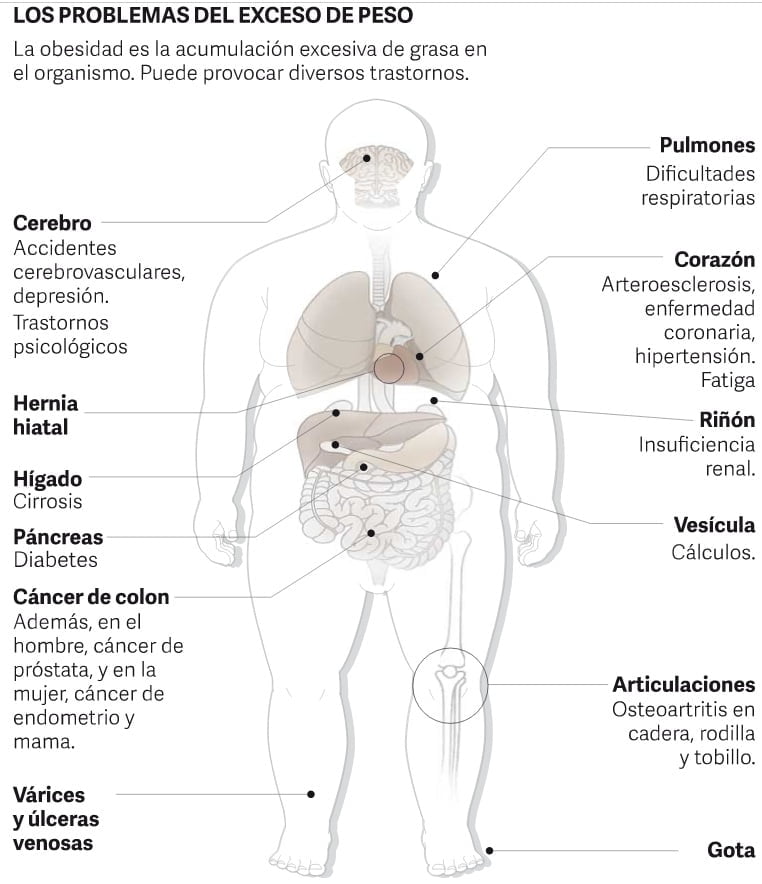
A United Nations study warns that it already affects 30% of women and 27% of men. Specialists attribute it to an excessive sedentary lifestyle and poor diet.

Overweight and obesity have become one of the main potential health problems in recent years. And Argentina is among the countries with the highest rates of overweight and obesity in South America. According to a new report presented by the UN agency for Food and Agriculture (FAO) and the Pan American Health Organization (PAHO), Argentina doubled obesity rates between 1980 and 2014, both in men and women. And not only that: we are the country in Latin America and the Caribbean with the most obese adult men.
The report "Overview of Food and Nutrition Security in Latin America and the Caribbean" reveals that in Argentina the prevalence of obesity in adult men went from 12.5% in 1980 to 26.7% in 2014. And as for women, it went up from 15.1 to 30 percent.
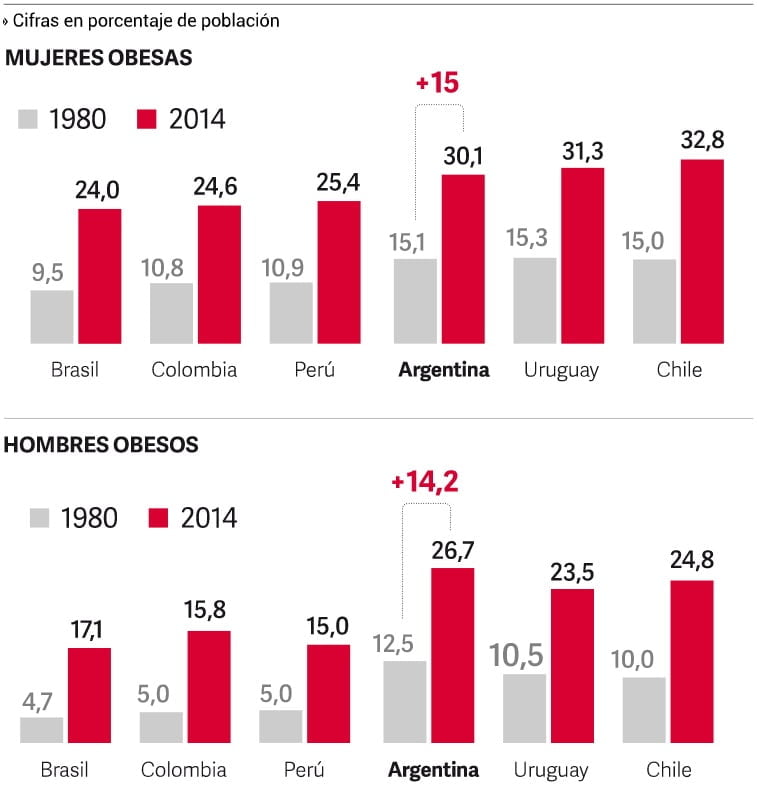
According to the report, among South American countries, Argentina has the highest proportion of obese adult men (26.7 percent), followed by Chile (24.8 percent), the Bahamas (24.6 percent), and Mexico (23.7 percent).
Among women, the problem of obesity is more frequent and Argentina is no stranger to this phenomenon: 30.1 percent of women suffer from obesity compared to 26.7 percent of men. But, in this case, it ranks fifth among the countries in the region with the highest proportion of obese adult female population: Chile ranks first with 32.8%; Suriname follows (32.2); Uruguay (31.3) and Guyana (30.3).
Specialists warn that in the last 40 years there has been a paradigm shift in both diet and habits. Nowadays we eat poorly and move little. The results are visible. "On the one hand, the way we eat has changed. Today we have many components (in foods) that when they are approved the only thing that is taken into account is that they are not carcinogenic, but they are obesogenic. For example, high fructose corn syrup, which is totally obesogenic. It is used in pre-cooked foods and is a type of sugar that causes a lot of insulin to be released, which makes these products more fattening," explains Dr. Alejandro García, doctor, to Clarín. endocrinologist. On the other hand, he says, we move less and less. "The activity index of a boy who plays with a cell phone or tablet is zero. That is also why there is so much obesity, more than what we eat is what we do not move," he adds.
In fact, childhood overweight and obesity is another problem to be addressed in the region and specifically in Argentina. "Regarding childhood overweight - says the FAO report - this affects 7% of children under 5 years of age in Latin America and the Caribbean, a figure higher than the world average. The concern, in this case, lies in the increased risks of diseases and other health and psychosocial complications in childhood and adolescence," adds the study and recalls that an overweight child is more likely, in adulthood, to develop cardiovascular diseases, diabetes and several types of cancer.
“The consumption of ultra-processed products is directly related to the increase in the prevalence of overweight and obesity, as well as non-communicable diseases, said the director of PAHO, Carissa F. Etienne, during the presentation of the FAO and PAHO study.
According to another work also published today by the prestigious British magazine The Lancet, between 1975 and 2016 childhood obesity grew tenfold worldwide. As for Argentina, this study reveals that obesity in boys (between 5 and 19 years old) went from 5.4% to 20.8% and in girls, from 4.5% to 12.9%. And overweight already affects 41% of boys and 31.9% of girls. The study, carried out by the World Health Organization (WHO) and Imperial College London, indicates that the total number of children with weight problems amounts to 124 million worldwide.
“Overweight and obesity represent an imbalance between food intake and energy expenditure, with a subsequent accumulation of body fat that represents a health risk,” says the FAO report. And it identifies among the causes, the change that occurred in eating patterns in that 34-year period, with a greater availability of ultra-processed products and a decrease in traditional culinary preparations, prepared with fresh and healthy foods.
"In the world, of the three large groups of nutrients - proteins, fats and carbohydrates - the most expensive are proteins. We in Argentina do not have that problem. We have access to proteins in quantity and quality, and it is something that does not occur in other places in the world. So we must return to natural food, for example a steak or grilled chicken, that is a healthy meal," explains García.
In this, the role of the school is also important. «To change the paradigm, we need to start at school. There the kids can only buy cookies, and there are practically no fruits. You have to start changing from the base. We have to change from below," concluded the specialist.
Hunger increased in the region
In parallel with the increase in obesity, the FAO and PAHO report warns that hunger increased for the first time last year in the region, after more than a decade of decline, reaching 6% above the previous measurement.
In six of the 32 countries measured – including Argentina, where there was an increase of 0.2 percentage points between 2013–15 (3.4%) and 2014–16 (3.6%) – malnutrition increased, already affecting 42.5 million people in the region, which represents an increase of 2.4 million people.
If these indicators persist, the FAO and PAHO warned, the region will not be able to meet the goal of eradicating hunger and malnutrition by 2030, one of the Sustainable Development Goals.
“With hunger on the rise, it is very difficult for the region to achieve Sustainable Development Goal 2, Zero Hunger,” said Julio Berdegué, FAO Regional Representative.
Although hunger levels fell in 21 countries in the region and remain low compared to the rest of the world, the absolute number of people suffering from hunger rose in Latin America and the Caribbean, "and there are signs that the situation is deteriorating, especially in South America, where hunger increased from 5% in 2015 to 5.6% in 2016."
"We're on the wrong track. The region has taken a significant step backward in a battle that it had been winning. We cannot tolerate the current levels of hunger and obesity, as they will cripple an entire generation of Latin Americans and Caribbeans,” warned FAO Regional Representative Julio Berdegué.
The worst situation in terms of the prevalence of undernourishment is in Haiti, where nearly 47 percent of the population – i.e., 5 million people – suffer from hunger. This number represents almost two-thirds of all undernourishment in Caribbean countries.
Source: clarin.com

